
FDA-Approved vs. Compounded GLP-1: What’s Actually Different in 2026
Most of what you’ll read online is written by someone trying to sell you one or the other. We review providers — not make them. Here’s the straight comparison.


Medical Disclaimer: This content is for informational purposes only and does not constitute medical advice. GLP-1 medications require a prescription from a licensed healthcare provider. Talk to your doctor before starting, stopping, or changing any medication. Compounded medications are not FDA-approved finished drug products.
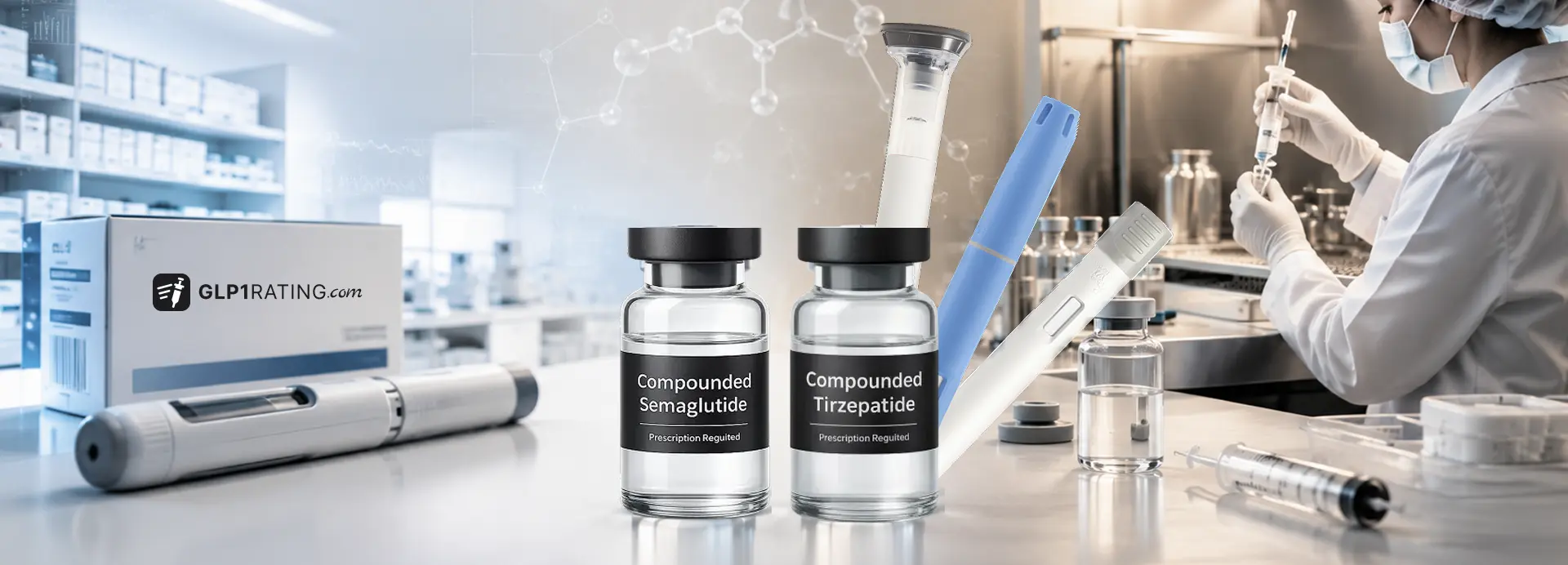
Side-by-Side: The Key Differences
| Factor | FDA-Approved (Brand-Name) | Compounded |
|---|---|---|
| Examples | Wegovy, Ozempic, Zepbound, Mounjaro | Compounded semaglutide, compounded tirzepatide |
| FDA Approval | ✅ Yes | ❌ No |
| Clinical Trials | ✅ Extensive (tens of thousands of patients) | ❌ None for compounded versions specifically |
| Manufacturing Oversight | ✅ FDA-inspected facilities | State pharmacy board (varies) |
| Active Ingredient | Semaglutide (free base) | May be semaglutide sodium or semaglutide acetate (different salts — untested) |
| Legal Status in 2026 | ✅ Fully legal | ⚠️ Mass compounding largely illegal; narrow exceptions remain |
| Monthly Cost (Cash Pay) | $199–$449/mo through NovoCare and LillyDirect self-pay (Wegovy pill from $149) | $99–99/mo where still available |
| Insurance Coverage | ✅ Many plans cover (obesity coverage expanding) | ❌ No insurance coverage |
| Delivery Format | Pre-filled autoinjector pens (set doses) | Multi-dose vials (you draw and measure the dose) |
What “FDA-Approved” Actually Means for GLP-1s
Four GLP-1 medications are FDA-approved for weight management in the US. Wegovy (semaglutide) and Ozempic (semaglutide) from Novo Nordisk. Zepbound (tirzepatide) and Mounjaro (tirzepatide) from Eli Lilly.
FDA approval means Novo Nordisk and Eli Lilly ran large-scale clinical trials — the STEP and SURMOUNT trial programs involved tens of thousands of patients — and demonstrated specific weight loss outcomes. The manufacturing process is inspected by the FDA. Every batch is tested for purity and concentration before it ships.
What FDA approval doesn’t mean: the drugs are cheap or easy to access. Without insurance, Wegovy lists at over $1,300 per month at the pharmacy. That’s what created the compounding market in the first place.
The better-priced access points (manufacturer prices checked September 25, 2026):
- NovoCare Pharmacy — Wegovy $199/month for the first two fills (through December 31, 2026), then $349/month
- LillyDirect — Zepbound vials $299 (2.5 mg), $399 (5 mg) or $449 (7.5–15 mg) per month
- Wegovy pill — $149/month at the starting dose, up to $299/month at higher doses
- AgelessRx — $65/month membership for Wegovy or Zepbound access ($50 for the Wegovy pill), plus the drug
With commercial insurance, many patients pay $0–$25 per month for Wegovy or Zepbound. Prior authorization is still required for most plans, but coverage has improved significantly in 2025–2026.
What “Compounded” Actually Means
A compounded medication is made by a pharmacy rather than a pharmaceutical manufacturer. Pharmacies have historically done this for patients with specific needs — a different dose than what’s commercially available, an allergy to an inactive ingredient, a form the brand-name doesn’t offer.
Compounding is legal and legitimate in medicine. The problem with compounded GLP-1s is that most of what got sold from 2022–2025 wasn’t individualized compounding — it was mass production of cheaper copies, often shipped to anyone who asked.
Three things to know about compounded GLP-1s:
The “same active ingredient” claim is complicated
Many compounded versions use semaglutide sodium or semaglutide acetate — salt forms of the molecule. These are chemically different from the semaglutide (free base) in Wegovy. The FDA has no data on whether these salt forms behave the same way in the body. That’s not theoretical — it’s a documented concern.
Add-ons like B12 and NAD+ aren’t clinically validated
Compounders frequently add vitamin B12, NAD+, or other supplements to their formulations. Some pharmacies market these as “enhancements.” There are no clinical trials showing these additives improve outcomes. Some patients tolerate them fine. Others don’t.
Pharmacy quality varies dramatically
503A pharmacies (individual patient compounding) and 503B outsourcing facilities (larger-scale production) operate under different oversight levels. The FDA has documented cases where compounded GLP-1s contained impurities, incorrect doses, or were produced by facilities that didn’t exist. The LegitScript certification is the simplest check — it means the pharmacy has been verified as operating legally.
The Legal Status in 2026 (And Why It Changed)
Compounded semaglutide was legal from 2022 onward because the FDA listed Wegovy and Ozempic as in shortage. When a drug is in shortage, compounding pharmacies can legally produce alternatives.
The shortage ended. Here’s what followed:
As of now, 503B outsourcing facilities (large-scale compounders) cannot legally mass-produce standard semaglutide or tirzepatide. 503A pharmacies (individual patient compounding) can still compound for documented individual medical needs — a specific dose not commercially available, a documented allergy to an inactive ingredient. But “I want it cheaper” is not a qualifying reason.
Some providers continue to offer compounded GLP-1s under these narrow exemptions. If you’re considering one, ask the provider exactly which clinical exemption applies to your prescription and which pharmacy is filling it.
Real Price Comparison (September 2026)
This is what people actually care about. Here are all-in monthly costs for both options — including consultation, medication, and shipping.
- Via telehealth (cash pay, no insurance)
- Wegovy pill (NovoCare): $149–$299/mo
- LillyDirect Zepbound vials: $299–$449/mo
- NovoCare Wegovy: $199 for two fills, then $349/mo
With insurance: $0–$25/mo for many plans
- Cash pay only (no insurance coverage)
- SkinnyRx injectable semaglutide: $99 first month
- Strut Health oral lozenge: $99/mo
- bmiMD injectable semaglutide: $119/mo on a 12-month plan
No insurance path available
The cost gap has narrowed significantly since 2023. If you have insurance that covers Wegovy or Zepbound, brand-name is now often cheaper than compounded. If you’re paying out of pocket, compounded is still meaningfully less expensive — for providers that can still legally supply it.
We cover real pricing in each of our provider reviews. Strut Health and bmiMD publish all-in compounded prices upfront; SkinnyRx publishes only its first-month price. AgelessRx offers brand-name Wegovy and Zepbound access for a $65 monthly membership plus the drug.
Red Flags: What to Avoid Regardless of Which You Choose
Which Option Makes Sense for You
There’s no universal answer. It depends on insurance, budget, your state, and what your doctor recommends.
Brand-name probably makes more sense if:
- You have insurance that covers Wegovy or Zepbound (or might with prior auth)
- You prefer an autoinjector pen with fixed doses — no measuring required
- You want the most clinical data behind your treatment
- Your doctor recommends it based on your specific health history
Compounded might still apply if:
- You have a documented allergy to an inactive ingredient in the brand-name
- You need a dose or form that’s not commercially available
- Your doctor has documented a specific clinical reason and uses a 503A pharmacy
- You’re transitioning and your current provider is still operating legally
If you’re being sold compounded GLP-1 without any of those documented reasons, the provider is either unaware of current regulations or choosing to ignore them. That’s worth knowing before you sign up.
What We Found Reviewing GLP-1 Providers
Frequently Asked Questions
Is Compounded Semaglutide Still Legal In 2026?
Mass-produced compounded semaglutide is largely illegal as of May 2025 — the grace period following the FDA’s shortage resolution has expired. Small-batch compounding by 503A pharmacies for individual patients with a documented medical need (e.g., a specific allergy or dose requirement) may still be permissible. Consult a licensed provider to understand what applies in your specific situation.
Is Compounded GLP-1 as Effective as Wegovy?
Unknown. No clinical trials have tested compounded versions for bioequivalence to Wegovy or Zepbound. Some patients report similar weight loss. Others don’t. The active ingredient may also be a different salt form (semaglutide sodium vs. semaglutide free base), which could affect absorption and efficacy. The FDA has no safety or effectiveness data on compounded formulations.
What’S The Difference Between Semaglutide Sodium And Semaglutide?
Wegovy contains semaglutide in its free base form. Many compounders use semaglutide sodium or semaglutide acetate — salt forms that the FDA considers different active ingredients. There’s no clinical data on whether these salts behave identically in the body. The FDA has flagged this as a safety concern in its official statements on compounded GLP-1 products. See the FDA’s full statement here.
Can I Still Get Compounded GLP-1 Through A Telehealth Provider?
Some providers still offer it under narrow clinical exemptions. Before signing up, ask them: which specific exemption applies to your prescription, and which licensed 503A pharmacy will fill it. If they can’t answer both clearly, that’s a red flag. The FDA is actively enforcing and has issued warning letters to 88+ telehealth companies in the past year alone.
What is LegitScript Certification for a GLP-1 Provider?
LegitScript is an independent certification body that verifies telehealth companies and pharmacies are operating legally and meeting regulatory requirements. A LegitScript-certified provider has been vetted for licensing, prescription practices, and patient safety standards. You can check any provider’s status at legitscript.com. Among the six providers we’ve reviewed, Strut Health, bmiMD and Found display LegitScript seals, SkinnyRx links to a LegitScript verification page, and LegitScript’s own lookup lists agelessrx.com and eden.health as certified.
Looking for More Answers?
View the full GLP-1 FAQ or email us at support@glp1rating.com
Sources & Research:
Medical Disclaimer: This content is for informational purposes only and does not constitute medical advice. GLP-1 medications require a prescription. Consult a licensed healthcare provider before starting any weight loss or diabetes treatment.