
How to Choose a GLP-1 Provider: 7 Real Questions to Ask Before You Sign Up
We’ve compared six GLP-1 telehealth providers on what they publish and what their customers report: pricing pages, intake steps, terms of service, pharmacy disclosures, and Trustpilot and BBB records. Same medication, very different rules. These are the seven questions we ask about each one.


Medical Disclaimer: This content is for informational purposes only and does not constitute medical advice. GLP-1 medications require a prescription from a licensed healthcare provider. Individual eligibility, pricing, and availability may vary. Always consult a licensed healthcare professional before starting any medication.

Why Provider Choice Matters More Than You Think
The medication itself is similar across most platforms. Compounded semaglutide is compounded semaglutide. The clinical trials that proved GLP-1s work used specific brand-name formulations — but many providers sell compounded versions that claim equivalent results.
What varies dramatically is everything else: the actual monthly cost (often higher than the advertised price), whether a real clinician reviews your health history, which pharmacy fills the prescription, and what happens when you have a question at 10pm on a Tuesday.
We’ve seen billing issues, sudden pricing changes, and providers that stopped shipping compounded GLP-1s overnight after FDA enforcement actions. The patients left scrambling were those who hadn’t thought through these questions upfront.
The 7 Questions to Ask Any GLP-1 Provider
What Is The Actual All-In Monthly Cost At Every Dose Level?
This is where most people get burned. The advertised price is often just the medication. It doesn’t include the consultation fee, shipping, or — and this is the big one — what happens to the price when your dose goes up.
Some providers charge the same rate at every dose (flat pricing). Others raise the medication cost as you titrate up, so your $149/month plan quietly becomes $249/month by month four. Some have mandatory membership fees on top. A few charge for labs separately.
Ask for the total monthly cost at starting dose, at mid-titration dose, and at maintenance dose. Get it in writing before you enter your card.

Does This Provider Serve My State — For The Medication I Actually Want?
Most GLP-1 telehealth platforms claim to operate in all 50 states. But state coverage often depends on the medication. Strut Health, for example, ships to every state except Arkansas but says certain medications aren’t available everywhere, and Found operates in 41 states.
If you’re specifically after injectables — which have stronger clinical evidence than oral or sublingual formats — check the state list for that medication, not just the general “we’re available nationwide” claim.

Is The Provider Legitscript Certified?
LegitScript is a third-party verification service that checks whether telehealth companies and pharmacies are operating legally, have proper licensing, and meet patient safety standards. It’s not a perfect signal — some legitimate providers aren’t certified yet, and certification doesn’t guarantee clinical quality. But a provider that fails LegitScript verification is a serious red flag.
You can check any provider’s status yourself at legitscript.com. Type in the company name or domain.

Who Actually Reviews My Health History — And Are They Licensed?
GLP-1 medications have real contraindications. Personal or family history of medullary thyroid carcinoma is an absolute contraindication. Active pancreatitis. Severe kidney impairment. Some providers catch these. Others send a prescription within 24 hours of a multiple-choice questionnaire.
The minimum standard: a licensed prescriber (MD, DO, NP, or PA) who actually reviews your submitted health history before writing a prescription. Video visit or async doesn’t matter as much as whether a real clinician signs off — not an algorithm.
If the only thing standing between you and a GLP-1 prescription is a form, that’s not medical care. It’s order fulfillment.

Do They Require Lab Work, And What Do They Check?
Many budget GLP-1 platforms don’t require any labs before prescribing. Some require labs only if your intake questionnaire triggers a flag. A small number require labs for everyone — and that’s actually the better clinical model.
At minimum, you want a provider who will ask about kidney function and thyroid history. A baseline HbA1c and metabolic panel give them a cleaner picture. This matters more if you have any pre-existing metabolic conditions.
If you’re healthy, have recent labwork from your regular doctor, and understand the risks, a questionnaire-based intake is a reasonable tradeoff for lower cost and faster access. If you haven’t had labs in years, the lower-friction approach comes with more unknowns.

What Happens to My Prescription if FDA Enforcement Changes Their Supply?
This happened to thousands of patients in 2025–2026. They were on compounded semaglutide from providers that had to stop shipping it when FDA enforcement tightened. Some providers pivoted to brand-name alternatives. Others just stopped.
If you’re considering a provider that offers compounded GLP-1s, ask directly: what is your plan if FDA enforcement changes your ability to supply this medication? Do you offer brand-name alternatives? Will you help with the transition?
Providers that have a clear answer — and a path to brand-name options — are more stable long-term than those that can only offer compounded products. AgelessRx, for example, offers brand-name Wegovy and Zepbound access for a monthly membership next to its compounded plans, and Found works with insurance for brand-name drugs.

Can You Cancel Month To Month — And What Are The Actual Cancellation Terms?
Several GLP-1 providers lock you into 3-month or 12-month commitments to access their lowest advertised price. The monthly rate you see might only apply if you prepay for a year. Cancel mid-year and the refund policy is often stingy.
Some providers charge a “commitment fee” or make cancellation difficult by design. The FTC took enforcement action against one GLP-1 telehealth company in 2025 specifically for opaque pricing — the settlement required them to show true all-in cost before checkout.
Read the cancellation policy before you enter payment details. It should take under 2 minutes to find. If it takes longer, that’s intentional.

Red Flags We’ve Seen in Our Provider Research
These aren’t hypothetical. We encountered each of these across the providers we reviewed or researched.
Our Reviewed Providers at a Glance
We’ve verified pricing and checked LegitScript, Trustpilot and BBB status for each of these. Links go to full reviews with detailed breakdowns.
| Provider | Starting Price | Medication Type | LegitScript | Trustpilot | Our Rating | Review |
|---|---|---|---|---|---|---|

SkinnyRx
|
$99 first month
|
Injections and daily tablets (sema + tirz)
|
 Yes |
·
5,452 reviews
|
||

AgelessRx
|
$99/mo (microdose)
|
Compounded GLP-1s + Wegovy & Zepbound access ($50–$65/mo membership)
|
Yes
|
·
2,580 reviews
|
||

Strut Health
|
$129/mo (injection)
|
Oral lozenge, injectable sema, oral & injectable tirz
|
Yes
|
·
783 reviews
|
||

bmiMD
|
$119/mo (12-month plan)
|
Injectable sema & tirz, microdose, NAD+ & Sermorelin
|
Yes
|
·
879 reviews
|
||

Found Weight Loss
|
$99/mo insured, $169 cash
|
GLP-1 + behavioral health + insurance support
|
Yes
|
·
771 reviews
|
||

Eden (TryEden)
|
$99/mo, every dose
|
Compounded GLP-1s + brand-name pens ($1,399+/mo)
|
Yes
|
·
4,983 reviews
|
Prices and ratings checked September 24, 2026. All-in monthly costs may vary with dose escalation and plan length. See our editorial policy →
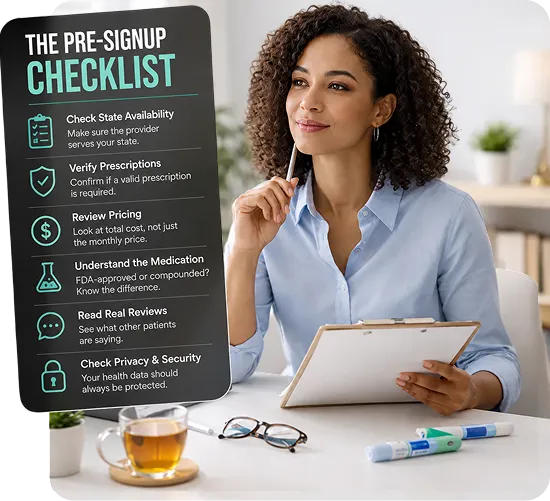
The Pre-Signup Checklist
Run through this before entering your payment details. Each item should take under 2 minutes to confirm.
Not sure which provider fits your situation? We’ve done the research. Start with our provider reviews →
How to Choose a GLP-1 Provider – Frequently Asked Questions
What’S The Cheapest GLP-1 Telehealth Provider In 2026?
SkinnyRx charges $99 for the first month of injections (later months are priced at checkout). For ongoing injectable semaglutide, bmiMD is $119/month on a 12-month plan ($159 month to month) and Strut Health is $129/month. Keep in mind that if you have insurance, brand-name Wegovy or Zepbound may actually be cheaper after prior authorization.
Do I Need Insurance To Use A GLP-1 Telehealth Provider?
No. Most GLP-1 telehealth providers operate on a cash-pay model and don’t require insurance. You pay directly each month. If you have insurance that covers Wegovy or Zepbound, Found Weight Loss works with insurers and handles prior authorization. AgelessRx offers brand-name access for a monthly membership, but you pay the self-pay drug price.
What Does Legitscript Certification Actually Mean?
LegitScript is an independent company that verifies whether telehealth providers and online pharmacies are operating legally — licensed in the states they serve, following legitimate prescribing practices, and not selling unapproved products. It’s the closest thing to a quick legitimacy check available to patients. You can verify any provider at legitscript.com. It doesn’t guarantee clinical quality, but a provider that fails the check is worth avoiding.
How Long Does It Take To Get GLP-1 Medication Through Telehealth?
Most providers complete the intake review and issue a prescription within 24–48 hours. Shipping typically takes 2–5 business days for standard delivery. SkinnyRx offers free overnight shipping on all orders, which is faster than most. Providers that ask for lab work can add 3–5 days for results before prescribing. Total time from signup to first dose is typically 3–10 days depending on the provider and your location.
Should I Choose Injectable Or Oral Semaglutide?
Injectable semaglutide (weekly subcutaneous injection) has the most clinical evidence — the STEP trial program used injectable formulations. Oral and sublingual compounded forms have less data on their absorption and effectiveness, particularly because they often use different salt forms of semaglutide than what’s been clinically tested. For people who want the strongest evidence behind their treatment, injectables are the better-supported choice. For people who want needle-free access and are willing to accept a less-studied format, oral options exist. Discuss with your prescriber based on your situation. Learn more in our FDA vs. compounded GLP-1 guide.
Looking for More Answers?
View the full GLP-1 FAQ or email us at support@glp1rating.com
Medical Disclaimer: This content is for informational purposes only and does not constitute medical advice. GLP-1 medications require a prescription. Consult a licensed healthcare provider before starting any weight loss or diabetes treatment.
